Panel event - december 2025
Hosted by Taylors of Harrogate, this special event brought together industry leaders for a morning of tasting, discussion, and connection – all while raising funds to bring clean water, sanitation, and education to coffee-growing communities through Project Waterfall.
There was a guided coffee tasting, a thought-provoking panel discussion, and a delicious Bettys lunch in the heart of Harrogate.
Moderator: Frank Tanner from Taylors of Harrogate
Panellists: Andrew Tucker from Volcafe, Tom Wilkinson from Dark Woods Coffee, Rebekah Kettrick from Cafédirect, Holly Kragiopoulos from North Star Coffee Roastery, Will Woodhouse the UK Barista Champion of 2025
Our expert panel dove into the intersections between water, sustainability, sourcing, and quality in coffee – sharing insights from across the supply chain.
event audio:
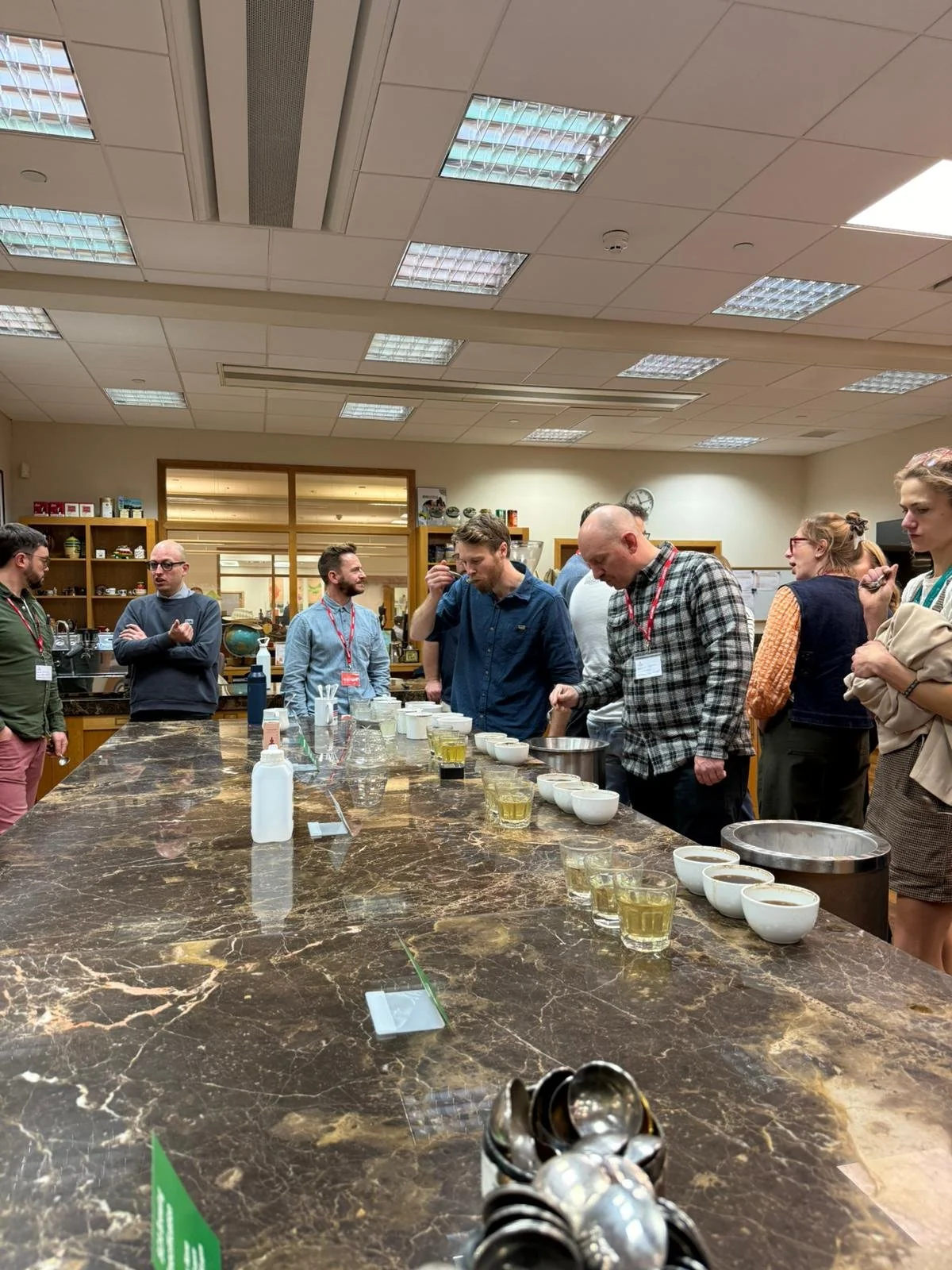
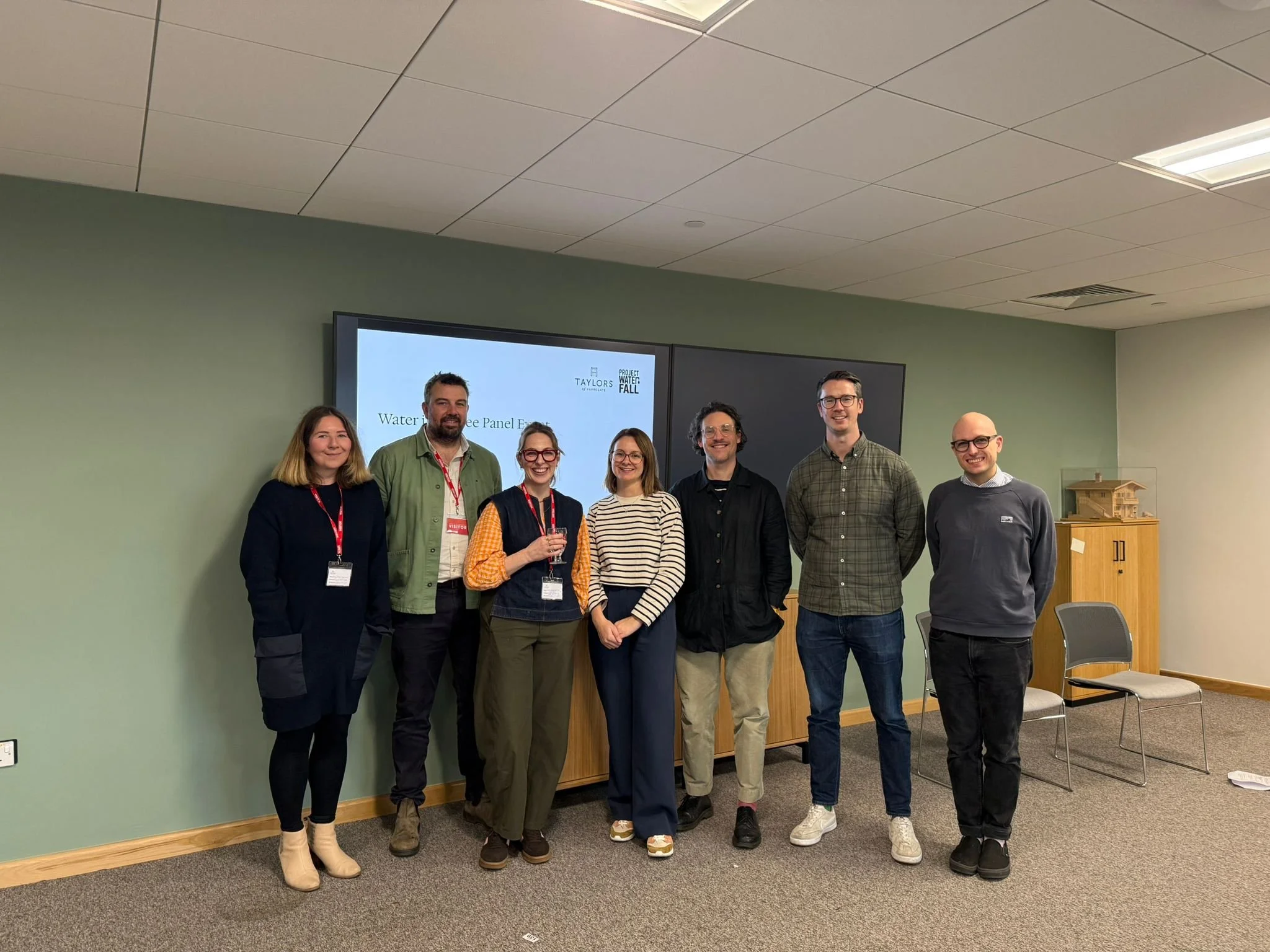
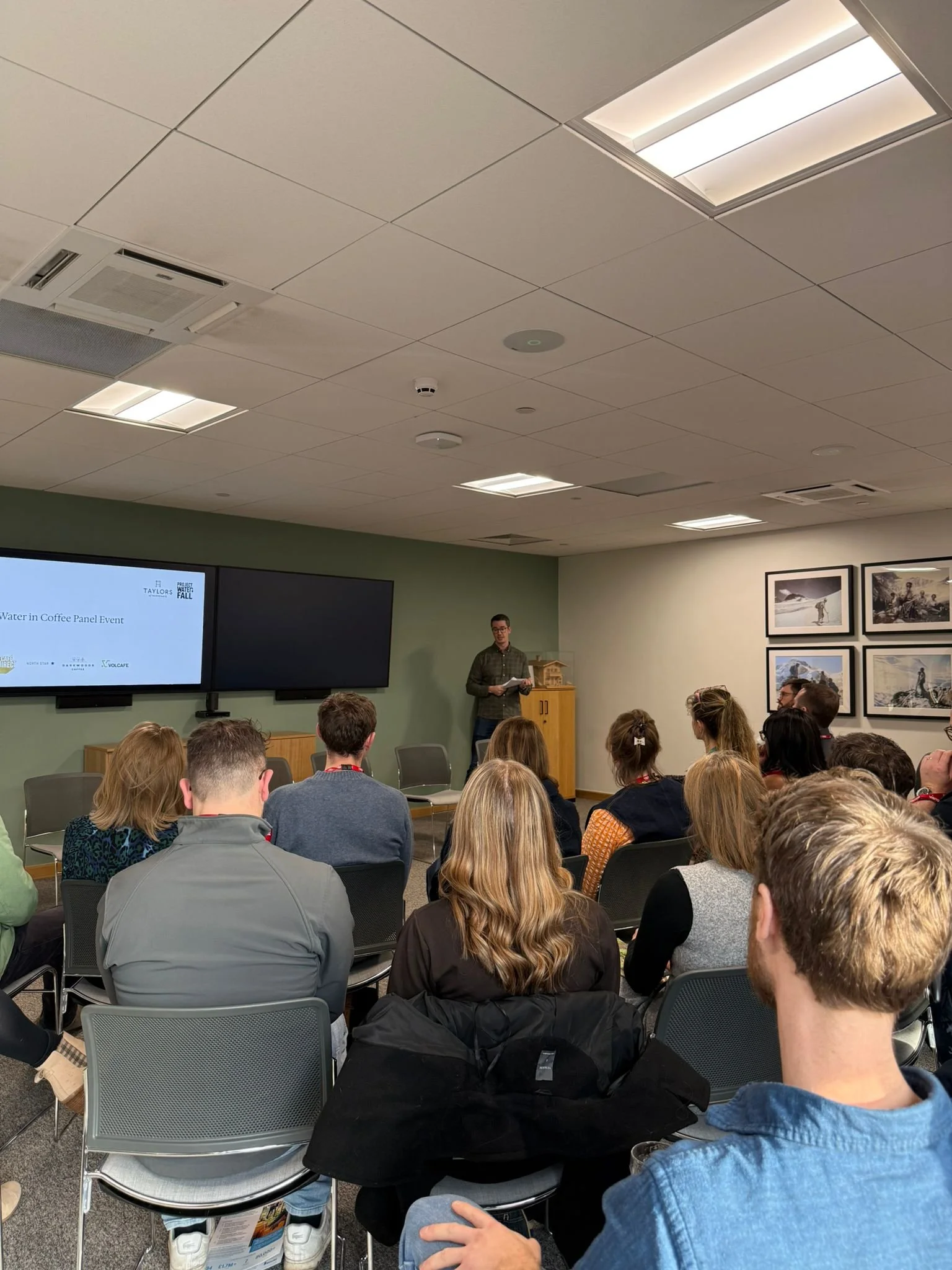
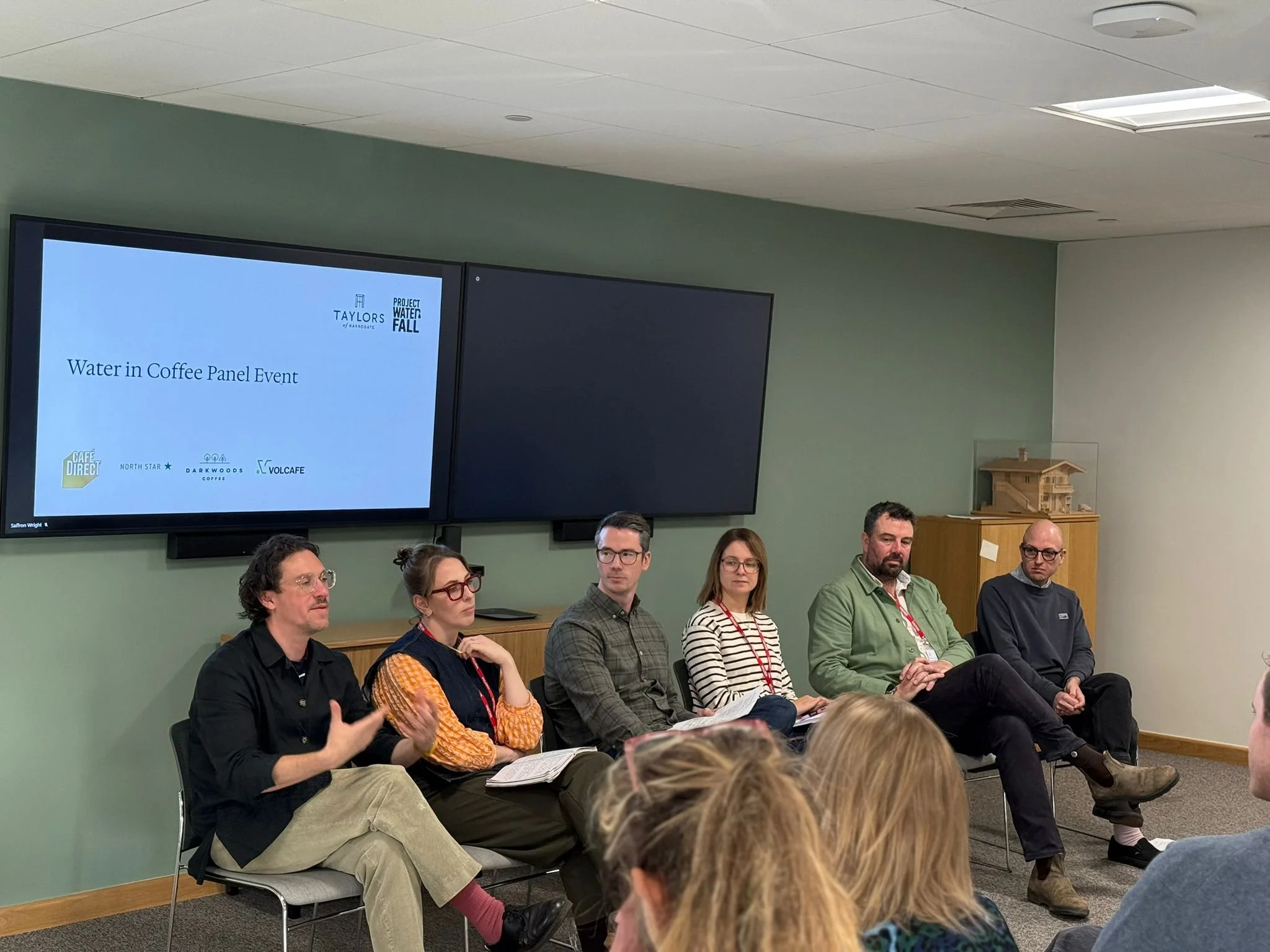
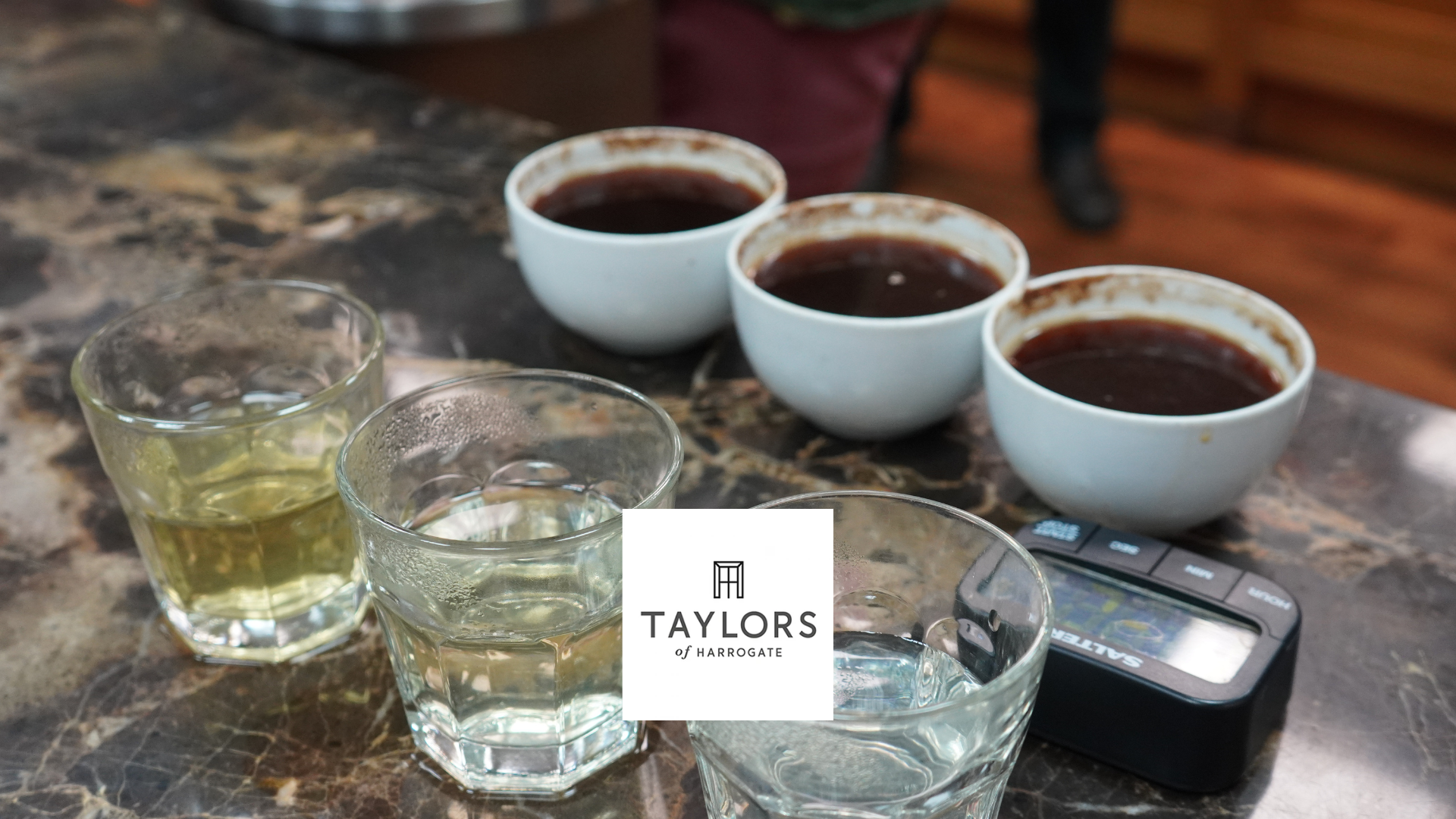
Image 1: Coffee and Tea Tasting
Image 2: Left to Right; Roxy Rocks-Engelman, Andrew Tucker, Rebekah Kettrick, Holly Kragiopoulos, Tom Wilkinson, Frank Tanner, Will Woodhouse
Image 3: Frank Tanner speaking to guests
Image 4: Left to right; Tom Wilkinson, Rebekah Kettrick, Frank Tanner, Holly Kragiopoulos, Andew Tucker, Will Woodhouse
event transcript:
December 5, 2025, 11:30AM
1h 42m 44s
Frank Tanner
Just felt a little bit of a hush in the room, so probably good time for us to crack on with the panel. Think in a good way. We overestimated a little bit in terms of how much time we need for the tasting.
Hopefully that means lunch comes a little bit earlier, but let's let's see what we can negotiate with the staff cafe. The good thing is this. Give us a little bit more time to really drag the panel.
If we have questions, we can take advantage of the time that we have.
So, without further ado, we'll get started. So I've titled the panel From Cup to Source; Water’s role in coffee.
It's quite difficult to like, bring together a lot of the different themes related to water, so now as I mentioned earlier, before we could be talking about TDS and we can be talking about the influence of minerals on flavour or at the same time we could be talking about a mother who doesn't need to walk for four or five miles to go and pick up potable water to supply to her family.
So I'm trying to do is bring us on a bit of a journey in terms of taking you out here and now quality all the way through back-to-back to origin.
So I'll crack on.
We've got an esteemed panel on here which I'm really pleased about and I think we'll just get started with some introduction. So I might start over here, Tom, if you just introduce yourself.
Complete role a little bit about what you.
Tom Wilkinson
My name is Tom, I'm the trainer and head of customer support at Dark Woods Coffee. So we're at Huddersfield based roaster. I’ve been at the company 8 years; it's 11 years old. As a business we're we're quite closely aligned in geography and history with North Star.
We managed to not tread on each other's toes too much, but yeah, my role is getting customers set up. So predominantly training, we've run a training school there and then general hand holding for as long as they buy our coffee.
Holly Kragiopoulos
I’m Holls, I'm the co-founder and CEO of Northstar coffee roaster.
So we set up in 2013 in Leeds. It's the first roaster in the city and we now have two of our own coffee shops.
Online coffee supply and wholesale partnerships across the UK.
Like what Tom said- I think that we were just saying how blessed North is have such great coffee businesses actually now and not so much skill set. And that's something that we've been really excited to sort of see developing the last 12 years that we've been going.
Frank Tanner
I did introduce myself earlier, but my name is Frank Frank Tanner. I'm Responsible Sourcing Manager at Taylors, so as well as the value chain investment programmer that I mentioned to you earlier. I also work closely with Coffee-buying teams, packaging-buying teams to look at the way that we structure our contracts, and the way that we can approach the pricing of our long term contracts and making sure that we're fit for the future for that as well.
Thank you all for coming.
Rebekah Kettrick
Hi, I’m Bex, I'm the coffee buyer of Cafe Direct, who were a southern coffee company until three years ago when they acquired the Beulahs UK business in Holmfirth. So now firmly rooted in the north, which as you can tell from Max, and I am too. So very glad to join that business in January of this year.
As the coffee by your manager, which is a role I've held in in other coffee companies previously, but looks very different in the world of cafe direct. Who are a social enterprise founded to improve the livelihoods of smallholder producers.
So being a buyer in that business is not about negotiating price. It's about working with the producers to understand how the long term we can work together to improve their experience of being a coffee farmer and their lives and the communities.
Thank you for inviting Mark.
Andrew Tucker
Hi, I'm Andrew. Thank you for having me. I'm absolutely from the South. So I'm sorry to say that I'm not deeply rooted in the North.
Yeah, I've come up from Devon, but I run Volcafe UK, so we are a global export and import company. I think the 3rd or maybe 4th largest green trading business in the world. So we have around about 11% or 12% of the global coffee market trading through our books and we are vertically integrated from origin through to destination. So we have export facilities, mills, buying stations, and labs all over the producing countries. And then we have the import offices in every major consumer market around the world.
So my role is running the import side for the UK and the Irish market.
Thanks for having me.
Frank Tanner
The North welcomes you.
Andrew Tucker
I've got northern blood in a little bit.
Will Woodhouse
I'm Will and part of the Innovation Team here at Taylor's; I think Frank's probably told you enough about Taylors, and I think I'm mostly on this panel because I am the UK barista champion.
Frank Tanner
Brilliant, as I said an esteemed power panel.
So you know, I talked a little bit before around, and you saw in the coffee tasting room, the impact of water on tea and coffee quality.
I'm kind of interested from you, Tom, from your perspective, just like how important is water in coffee quality?
Tom Wilkinson
I think possibly some of the reason why we have so many good coffee roasters in the North might be to do with the water. Perhaps if you kind of see it parallel to the beer brewing industry, you get clusters of businesses and brewing styles based on mineral content in water, things like Dublin Water and Guinness and Burton, in the Midlands in terms of that kind of how water impacts their coffee flavour, sorry, you know, drinks flavour. So I think as an industry we've been really, really late about 200 years behind brewing. Basically, Oh, hang on water.
And it was really only about a publication of a book called Water For Coffee, which some of you may have tried to read. I certainly did. I went straight to the back where the cartoons are.
Because I'm very much not a chemist.
But it really opened my eyes to some of the, well, kind of gave a lot of understanding to things that I'd experienced in the coffee industry that had otherwise been really, really mysterious. So for me it was more about connecting some of those dots and realising that there was a big factor at work in terms of how coffee behaves and how it's enjoyed by consumers, that we hadn't really countered for.
So things like going to London Coffee Festival and exhibiting coffees and their tasting dreadful.
Thinking that there's something to do with machines or you know, just not really being able to work out what was going on.
Really quite profound things like crema not being the right colour or like coffees tasting old when they were not and you know it wasn't subtle stuff.
And because you're away from your kind of comfortable space of the roastery, you normally blame equipment or things like that, or blame the roaster for not resting the coffee or something like that.
But yeah, doing cuppings down South for for customers and finding that all of your most fancy coffees or the floral ones or the geishas and really things that you're going to pull them over with just taste, you know, really flat. And then having a really kind of awkward internal dialogue where you're thinking how am I going to explain all of this? If you know people already think coffee people are nuts. If I start trying to blame the water.
Then going to, you know, think it's ridiculous.
Frank Tanner
It's interesting because almost that retail, where somebody's just buying a pack of the shelf, whether it's from supermarket or a coffee shop or wherever, we have no control over what they're doing, whereas in...
Tom Wilkinson
No, I mean, it's not finished product, it's what makes it kind of different from other food and beverage industries is you're selling a potential experience. But it's sold as a completed experience. You've got tasty notes on the front. You are going to taste this, and there's so many caveats to that. There's huge opportunity for, for disappointment, which I think is part, you know, people that don't get coffee, quite understandably, it's quite technical on some level, some levels it's not; there's some basic things that people can do or not do, but I think we forget just how, how different from our own experiences of roastery, the customer experiences is we're aware of that is.
Frank Tanner
I think where there’s a bit more opportunity for controls at hospitality level, right?
Tom Wilkinson
Well, yes and no, as a trainer, I would say I could, you know, I'm professionally able to make sure that people make a coffee properly and well, I’ll leave that comment then.
Frank Tanner
I'll let that one hang.
Tom Wilkinson
Yeah, I'm still in a job. But, you know, there's always more that you feel like you could do in terms of, like, you can't physically make the coffee for them. You can't control the the labour market in a rural area where you can't get good hospitality stuff, you can't legislate for any of those things. You can help and support, but yeah, there's so much so much that you can't control, well you know, as a, as a coffee roaster anyway.
Frank Tanner
From my experience, North Star, you have got some pretty good stuff.
Can you talk a little bit about that?
Can you talk a little bit about how you manage consistency and how important water is at that level.
Holly Kragiopoulos
Yeah, I think obviously echoing what Tom was saying, it's, there's so many variables that we're trying to control and just to maintain our brand consistency across our wholesale customer base. And it is, it's a, it's a full time job. You know that's why there are jobs for...
It's two, yeah.
That's why coffee training is such an important offer, I think, of any wholesale coffee provider. And I think when it comes to water, all we can really do is try and remove that as a variable from the set up. And we do that through filtration, through sort of remineralization. And sort of essentially working with really trusted suppliers to essentially, we kind of offer a bespoke water set up for every single wholesale customer we work with, we sort of test the water that coffee shops and then kind of suggest like a bespoke setup that's going to kind of bring out the best of the the coffee in the environment. And it then means that our training can focus more on all the other variables, you know, that we have to control in terms of dosage and, you know, brew time and coffee freshness, rest periods, etcetera.
But it's yeah, it is a, It's a huge consideration and it's something that we have to stay on top of all the time in terms of when you know water filtres are being changing, you know swapping out, and we're kind of I think it's something that the whole industry is like recognising now because equipment is actually now being kind of developed with apps that can kind of read that information and sort of ping off a kind of a warning as to when a filtre is, you know, passed past its, kind of, utility really.
So It's something that's kind of it, I mean, it's 98% of a cup of coffee is water. So it's it's obviously something that has huge power over its flavour, but it's also something which is maybe you know, not taken as seriously as as other industries.
And I had like a similar story to Tom to share, which was from the days I was working for Falcon Specialty, which was my first job. And then I don’t know if you were at a cupping that I did in Bristol; extract the showcase of unique lots when you were there...
Yes, well, that campaign was a disaster because we brought some microlog coffees into the UK and had such limited sample material, like 20 grammes; you know, one row space made available and we decided to take it on the road and do a sort of cupping for all of the roasters in Bristol, and I kind of set it up and went down the line really quickly before everyone dove in and I just suddenly thought, Oh my, you know, these microlots, which I think we were trying to sell for like 10 lbs a kilo, which at the time was just like terrifying.
You know what, $0.20?
Yeah, yeah, actually terrifying. But yeah, the coffees were just really flat. And, you know, just not really sort of delivering what they had in the cupping lab in Harrogate, basically; So it was you pretty much were just directing people to taste them almost cold.
To sort of, like, really get everything everything out of it and and ever since then, it's something, Yeah, I've been really on top of whenever I have to go and take our coffee on the road.
Well, Tesco ashbeck... Does the job. So so yeah.
Frank Tanner
I feel like we've got a bit to learn from other industries on that because if you look at fever tree, right and how they've marketed the element, I know we're talking about tonic water and not actual pure water. But if you look at how they've marketed the fact that 98% of your gin and tonic is the water, that's the first thing I thought of when I was like, so they popularised in the eyes of the consumer how your, let's say, add-on ingredient is so important and I feel like in coffee, despite Max's best efforts with his book has made that quite still a difficult conversation to digest.
Holly Kragiopoulos
I think the main difference there is that the 2% of that product is then also something that's you know subject to so many of the variables. As opposed to gin where you’re just pouring out.
Frank Tanner
Yeah true.
Holly Kragiopoulos
It's that is that the concept of water, like to the consumers, also being something that they have to think about investing you know and like it can be as simple as a Britta filtre jug at home, you know, just to try and like bring bring some consistency. But it's just you've got such a limited attention span of the consumer, you know, and you're already trying to deliver so many, so many bits of...
Frank Tanner
...Variables, yeah.
There's too many things that can go wrong getting coffee, unfortunately. Lots of things that can go right. But yeah, one of them.
So just in the in the tasting room there it made me think that as you mentioned, you’ve worked in a few quality role and buying role across a number of different companies.
For you like, how critical is water in the cooking lot and what can you do to ensure consistency there?
Rebekah Kettrick
Yeah.
I mean I feel like Tim did a great job of answering that question actually downstairs. I think we're all able to see the impact that water quality has on on the cup. And I guess if you're in a roasting company and you're blasting coffee labs as we are, you're able to really tightly control that variable And you know the lab at the moment, the water similar to here, we don't really need to intervene. It’s pretty much on SCA specs. But then that got me thinking about all the all the other labs that I've tasted coffee in and you know, kind of really importantly the tasting labs at origin.
I was thinking I can't say I've ever paid that much attention to like how they're managing the water in those labs and it will obviously be hugely varied from set up set.
And I guess holes, which having saying like that would be one of the reasons that I would want to be making like buying final buying decisions in my own lab in my own very closely monitored environment.
Because, yeah, as much as coffee people aren't chemists. I think we're very kind of nerdy when it comes to our coffee product.
Yeah, exactly. So I think it's again, it's one of those things. Before you start to think about it, it's just routine, but actually hugely important.
Frank Tanner
I think the kind of, as you say, the difference from producer to producer based on their like capacity, and like, the resources that they have available to them is massive. So I've seen everything from kind of water straight out the top into the kettles and I'm thinking hope that's really being boiled, to you know, in Brazil where they've got more advanced systems, as could imagine, and it's monitoring it live, how much water is going in and sticking it to exact SCA protocols.
Rebekah Kettrick
Yeah, which is ironic because I feel like when I kind of explain what coffee cupping is to someone who's never done it before, you're like, well, the reason this process is what it is is because it doesn't require a huge amount of, like, expensive equipment. And you can replicate it across all these different regions. But actually that's massively taken for granted that everyone has access to water service specification.
Frank Tanner
Well, I'm not intentionally skipping you, by the way, Andrew. We just happened to sit slightly in order of the way. Now I've got to start leapfrog you to stick with the script. So with the UK BC champion, what role does water play at the Competition level of coffee brewing?
Will Woodhouse
So it's massive. Like as you've tasted here, the water we've got coming out of our taps in this building's really nice brewing coffee with. So when I roasted the coffee for the British Championships, I cooked it, you know QSC’d it with our tap water. Anyone who's ever sold an espresso machine knows that you'd need to filtre that water. But in this building, I'm just putting tap water in our Espresso machine.
And that would terrify most of Britta.
Yeah, we do the same. We don't want filtres on our kit at all.
It's amazing, isn't it? And like it's unfortunate and it saves a lot of money, but it's like we do take it for granted and when I roasted that coffee, we had sort of like 9 or 10 of us come taste espressos of it and I, you know, collated this data and built sort of flavour wheel isten of what This coffee tasted like to nine of us here in Harrogate. And then I took it to Milan and we went to the BWT water showroom. And it tastes like completely different coffee. Thankfully, it tasted like an even better coffee, and I was in such a good mood.
Like that's never happened to us.
Sparkling florals and that like, weren't there in Harrogate, maybe because it was only 5 days off roast in Harrogate, but the water was so different and so I was really excited. I was like great BWT as the filtre sponsor.
This is the water.
And then we got to the venue in Milan, and theoretically by spec the water was the same like they, you know, put it through the reverse osmosis re-mineralized at the same. But those sparkly floral notes weren't there anymore.
And it's because of the different source water that's coming into that building compared to. So like it's crazy how much a little bit of difference, especially with espresso brewed coffee, because it’s so intense. It makes massive difference, so I'm in the right water or system water. What you want the end person to see? Super important.
Frank Tanner
But yeah, no, it's it's interesting, isn't it? And that that's probably the highest level of water quality that you get for coffee. And even then, if the source water was different, it's altered the cup. So it goes to show we're doomed. Essentially, if you're putting your kettle on in your house.
I'm going to have to invest in my new water system to go with my grander and espresso machine.
Andrew, so you know, Volcafe source from a lot of origins and I was wondering in terms of how water at origin can affect the quality of coffee that arrives here. So how the use and cleanliness of water, how do you think that affects what arrives at destination countries?
Andrew Tucker
Yeah.
I mean, everyone's kind of touched upon. It's it's influence along the supply chain. But for us, I guess I quite often, maybe it's in my DNA, but I link things back to the commercial sort of element of how variables adjust the supply chain. So with water, if you have a lab in an origin which is producing a coffee that in their eyes is to a X spec.
And that's not received on the other side of the supply chain to the same spec. Then you have an economic discussion, right?
So the control of water to as as Will said to try and iron out those variables.
Actually has a massive impact on flow of money around the industry too, because if you've got a debate or an argument or a, you know, a legal claim against someone simply because there's a part of your cup that doesn't meet your contractual spec.
It could be something as simple as water that's causing that.
I don't, I was thinking it's quite unusual, but when we talk about holes mentioned the water in Bristol was terrible. I've got a roaster client in Cornwall who routinely disagrees, let's say with some of the descriptures that we see in coffee. And then you buy their coffee, which they've roasted for the water in Cornwall and you really understand why, right?
So for me it's kind of like we need to try and iron out these variables in order to kind of smooth the process of contractual fulfilment, so that the money flows from A to B and vice versa, and it can become a very contentious issue, as Tom said, when you've got a customer who's basically saying what have you done wrong?
You know, they they come back to us. We then go back to origin and everyone's kind of looking at where could that source of problem or sort of inconsistency lie.
But for the origins, what I see certainly from our investment perspective is we're spending most of our money in our origin labs, not our destination labs to improve their their equipment consistency.
Because ultimately, if you're you're having a contractual placed against you based on quality, it could just be that they're water that they're bringing is wrong.
Frank Tanner
Interesting. Basically, the mineral content could define the impact on somebody's livelihoods.
Andrew Tucker
Absolutely. Yeah, right. So if you, if a roaster's decision is, oh, I don't like this coffee; there's a problem with the imports and therefore the exporter, therefore the farmer. All of a sudden, said farmer may not have that roaster as an end client anymore.
And it could simply be that we haven't got the right filtre in our labs along the supply chain.
Holly Kragiopoulos
Can I put in with a question?
Andrew Tucker
Of course.
Holly Kragiopoulos
Do you think with the muted sort of coffee value assessment that that might change that dynamic a little bit?
You going to say the same thing?
Andrew Tucker
Yeah. Yeah. Well, I guess that seems to be the intention of it, right? I haven't done the course, so I'm not experienced to comment on it, but I think that seems to be goal of it is trying to harmonise, let's say, the kind of lexicon around the way a coffee tastes and not the value attributed to it.
I think in principle, if I understand that, they're basically saying if this coffee meets what you want your coffee to taste like, then it has to have some value.
Holly Kragiopoulos
Yeah. And I think as surveying on a more holistic sort of basis can think the thing that strikes me is like, is there a world in which we can eliminate all variables will get every single thing...
Will Woodhouse
With the variable, that was the that was the problem, wasn't it? That humans can't do what we think, what they could do in terms of coffee protocol and coffee scores. And you have a couple of excellent competitions where the difference between the 1st and 3rd. They in the exact same same way.
Is half a point difference in value is.
And they found that professional couples Q graders would often be up to 15 points out in some cases when they retasted a coffee like it's not half a point. It's the difference between specialty and commercial.
So that the problem is is the humans and the over the emphasis over technicality. Yeah, we can't do this. Everyone that tastes our coffee is bringing a personal dimension to the flavour. So all of this water and brewing stuff has to be kind of set against that as well.
Frank Tanner
But it's kind of a luxury that the other industries, particularly on the grocery shelf, for example, in the space that Taylor's compete like the beer and the wine industry, doesn't have quite as much of this variable to deal with and to tackle. Because as you said, the end product is what the consumer is going to experience.
Yeah.
Where as we're relying on all of these other uncontrolled variables for the consumer to have that experience that we're promising that we're going to give them.
And that's not just in the kind of retail grocery environment. We see it with our roaster clients and then they see it with their wholesale clients and then they see it with the consumer. So it's the variability that's passed all the way down the supply chain and we can't control it, to a point, you know, it's it's never going to be controllable.
Holly Kragiopoulos
I guess just the more education people have around the variables that are impacted in coffee, they could decide for themselves how much time and effort that they want to invest in that. I think like whole said, we're already asking so much of our consumers.
That water also feels like an awful lot, yeah.
Andrew Tucker
But that that tasting downstairs kind of highlighted it. You know, we'll presume coffee enthusiasts may be fairly experienced cuppers here, right? And you're talking about a perfectly brewed black coffee in that lab. Where you can notice the nuances, but if you roast that darker and stick it in a 16 ounce cup with a lot of other ingredients that go into it- Can you really pick out those nuances?
So the challenge for the consumer is, you're telling me that this is really important and all these variables are uncontrollable, but I don't really taste that because you got 15 1/2 ounces of milk and sugar in there.
So like, that's actually quite a challenge, I think is whether or not the consumer is going to buy in as the variables that.
Frank Tanner
I think that's a challenge for all of us.
It's like coffee now to a satir most of the time going to be preparing to it will definitely taste coffee black butter. Drink it black. A lot of the time and to get this little nuances, nobody's going to be believe you without a taste of it, because the consumer's not.
I'm just going to move us on now from kind of brewing in quality into I guess responsibilities related to water in the industry and how that's how that's changing so.
I will start off with with you again if that works so.
Dark with the B Corp certified and there's a new water stewardship aspects that Bb Corps and there's a few of the B Corps here so people can feed in. But what does that mean for your business?
Tom Wilkinson
I guess I'll start by explaining B Corps to people because I still have to do this a lot. I think the assumption is that everyone understands this thing. A quick show of hands who has come across this term B Corp or has engaged with it a while. I guess it's kind of picking your audience.
I still have to explain to a lot of customers, what it actually is. So it's basically it's a, it's a third party platform for certifying businesses that have aspirations towards goals of sustainability, Environmental Protection and just general kind of respectful supply chain management. So all of the nice, fluffy things that you want your your product... you know, if you're a consumer, these are the kind of claims that producers and businesses make online. And it's a way of substantiating them and having a sort of a third party platform for stamping to say that, you know when you say these things on social media that they're born out in at least partially in reality.
So every three years you have to submit a fresh claim. They come in and investigate you so your score can go up and down. You can lose your certification. They basically can't be good. Once when people are watching and then be evaluated.
Fairly remorseless process, isn't it? To be honest, like one of our directors, Ian, whose background is in social enterprise rather than coffee, has really got the bit between his teeth with this. And I think if it hadn't been for his non coffee background, we would have really struggled to to get where we've got to with B Corps because it's hard work. But we've you know with his stewardship we've managed to improve our score hugely from the 1st to the 2nd certification. So I guess the challenge for us is are these additional scores, so we can get a higher score, are we going to risk getting a lower score because we've got more challenges to meet?
I have to be perfectly honest, this is something that we knew that was vaguely coming, but it's 18 months off or so, so we haven't actually had hard conversations about what that's actually going to look like and how we're going to manage it. But we do, we are aware of producers and you know, for meeting them and having those conversations that it's very much on their minds. So we have customers in Columbia, parts of Columbia that are have no access to to fresh rains, potable water. So they actively choose the processing methods in order to suit the local climate conditions. They do natural and highly processing, so we're already finding that just by nature of of the kind of business we have as a specialty roaster that a lot of the producers that we're working with are quite clued up.
They have access to resources, you know, we've worked with farms that have called in or actually employed university professors to fix their producing problems, and that's not a luxury that most of the supply chain has so.
I think we're going to find it easier as a specialty roastery, then we might as a commercial roastery.
But we do actively we we have to manage things like carbon footprint for the B Corp. So that's already something that we intervene with directly and actually with the help of one of our importers that we we do some reforestation and tree planting sdchemes. So rather than paying for someone else to do carbon capture for us, we're actually doing a physical thing that not only captures the carbon, but also directly benefits the people that we're we're trading with. So I imagine we'll work on similar principles, you know, that directly invest in part of B Corp is that you've developed this pot of money that you obliged to use for goods, and so they at least we're already in this kind of mindset of there is a part of money aside, you have to give away- One or two percent, depending on where you're at with it. But as we get bigger as a company, that pot gets bigger. So again, I think we're quite privileged in the sense that we already have this earmarked fund, we already are quite active and engaged at origin, but I think through having that conversation we realised how how much easier and it was going to be for us and for others and made us feel extra lucky.
And it was raining at the time, so this whole talk of, like, just been paying it down for the last week. So the idea of thinking about...
What's the scarcity?
Yeah, it's. It's hard to. Yeah, we've got next to a canal and a and a very aggressive stream. So it's, it's definitely not in the day-to-day, we're worried about, but.
It's yeah, as you say, it reaches all the way up too.
Frank Tanner
So how was think thinking about North Star, managing a roastery and coffee shops, pretty water intensive task. What? What have you been able to do in order to manage your water better and to to reduce your overall use?
Holly Kragiopoulos
I think on an operational level, again aligning with equipment manufacturers that kind of build that into how they, how they're kind of designing machinery and has been really crucial. So working with machines that you know have the programme short flushed group heads, you know, sort of like trying really trying to minimise how much water is used in the coffee shop setting it kind of. We were lucky to be able to kind of fit our roastery with facilities for the team so could make decisions minimising you know the tap heads that sort of minimise water and that's used more on a day-to-day basis. Yeah. I think the most important thing is just is that we try to do is kind of making sure that water is a very visible resource rather than something that's just taken for granted. I think it's so much of this this stuff is impacted from the culture that you have within the business in terms of how how kind of responsible everybody, how much responsibility everybody takes and that only comes through engagement and training, and stuff like that.
So we're a B Corp too. You know, it's a big part of our sort of our company culture to ensure that, like everyone in the team understands, all the aspects of that assessment and what it means and and the kind of role that they can kind of play in helping us improve and do better, really, so yeah.
Frank Tanner
So something that the assertive evade the staff structure so that everybody feels responsible for it.
Holly Kragiopoulos
Yeah, I mean, I'm forever envious of Ian's role at Darkwood, because this is something that's definitely hamstrung into my position in at Northstar.
Which is it's I speak that language. I kind of did a degree in sustainable development and then those focused on it. But I'm also having to kind of manage it alongside building management structures and you know, setting the strategy and all the rest of it, so.
But I think the benefit of doing that is it can't just be on my shoulders like it has to be something that's really integrated across the team in the business and that's that's not necessarily been a conscious choice. It's just happened because we've not got a sustainability manager or someone that takes that sort of direct responsibility for it's very much kind of grown and contributed from everyone in the business regardless of their role.
Frank Tanner
I think that's a benefit to that too as well, though, even though you're probably thinking it's a lot, it's a lot.
Holly Kragiopoulos
It might not always stay like that, but you know, I think for yeah, where we've got to know it's definitely been relying on the team effort for sure.
Yeah. Sorry. I just wanted to ask about how B Corp integrates the water and the sustainability side of things into and if it does have like a specific section or like criteria, how kind of that look?
Holly Kragiopoulos
I mean, we just reset I'd last week actually and we kind of just squeezed in on the model. Before the refresh, have you done the same before the refresh?
Tom Wilkinson
Yeah. So because we haven't actually had to be assessed with the new water stewardship criteria. So we we don't actually know exactly how it's going to look.
Holly Kragiopoulos
Up until now, though, it's been about the DU and measure how much water you use, have you got a reduction plan in place, basically?
And more for you rather than for your supply chain.
Yes. Yeah, I think, yeah, I think I've got a question on that coming up, right in terms of impacts projects and...
...
Frank Tanner
To be continued.
So Bex, you know, at Cafe Direct as you mentioned before, you work really closely with cooperatives. Could you tell us a little bit more about that? And then also how much does water feature in those conversations that you have of our brands sustainability challenges?
Rebekah Kettrick
Yes.
So Cafe Direct was founded in the 90s when the coffee price was super low and founded by tradecraft when trading and some other NGOs to basically move coffee from smaller producers into this market, try and sell it and and help them make an income. And we've been working with them ever since the early 90s. So kind of gown up with them, I guess in the last 30 years and have have worked with them on side a lot of their challenges.
How does water feature in the discourse? I would say so, I'm a year into the business and this year in particular, like, the main challenge for users and the cooperatives is around managing climate change at the impacts to their coffee production, and I guess that is around kind of the wet and the dry seasons that we used to have and how that looks now.
It Is enormously challenging from a productivity perspective, from a quality perspective and logistical as well. It's quite common to not be able to get access to some of those communities and also for them then to get the coffee out as well.
So I would say that is probably the main way that I kind of hear if I'm trying to generalise across that whole range of different types of communities that mention the impact of water.
And I guess in terms of you know what's been done to try and manage something which is like you know, so enormous and you know, something that we industrialists have imposed on those communities really is around water retention in soil, which organic farming practises help enormously with. We're working on biochar project in Uganda to to kind of help with that.
And then also different priorities that can handle those kind of dry up periods as well and we work with them as well. They did some amazing work there on varietal testing and then disseminated those plants out to their members to try and deal with the longer, dryer conditions that producers are exposed to, but it's just enormous and
Frank Tanner
Yeah, I think that's the thing as well, with water can be considered in terms of possible water, drinking water for the community, but also soil health, if it's used in the wash process; fermentation, it's so quite broad. You can even go to extreme weather events.
Rebekah Kettrick
So yeah, I mean I was looked. So we're fair trade company, 100% of the coffee that we buy is Fair Trade and Roxy mentioned that it was only quite recently actually that they embedded any standards around, like, water management and land use, which I felt quite surprised about.
And, when I looked into the fair trade premiums.
Is that we work with less than 1% of that is invested in water related projects, which again, I'm not surprised about and that's potentially because we're working on Central and South America where water scarcity isn't necessarily such an issue. And those communities tend to have more needs around education and healthcare for example.
That was quite eye-opening, actually. I don't know if that's kind of what you guys have seen as well, yeah.
Andrew Tucker
I guess if you open it up more broadly as well, there's so many like challenges within the coffee supply chain and you need to prioritise. You can't do everything all at once.
And I mean the way that we tried to do it, it sounds similar to what you're talking about is speaking first hand with producers, making sure that we understand what the needs are and that they're, you know, they feel comfortable, comfortable to be transparent about what some of those might be, water or it might be to do with human rights or it might be to do with education. And yeah, it's almost as though if the work is ever done in some ways, I think over time what we want to be able to demonstrate is, you know, if we've worked with a producer for 5-10 years, we can see the impact across a number of metrics. And I think water’s, you know, a big one depending on the context.
Frank Tanner
We'll just kind of look at things that like a bit of a different angle. You said your predominant over here as UK BC champion, potentially that's true. But also you know your innovation expert and I kind of want, I did wonder from an innovation perspective,
Like, how do you consider water in in product development?
Will Woodhouse
It's a good question because innovations are like super broad, especially like what we do here. But it's so very much varies from project to project. What we're working on.
My role predominantly is taking things that are ideas or concepts and making an initial prototype of first consumable version of that and that's always developed here using like our local tap water. But then I need to think if we sort of try and scale that up, we're transferring it to a Co-manufacturer, with things like the iced tea that we launched.
Like, how are they going to be brewing that tea? What water they're using? And you know, it's very good when you're working with great, you know, suppliers and you can trust the experts to be the experts. And they might have mineralized their water in a certain way to do that. Because the water you use effects very much how things are extracted as well as just an overall taste, it can be harder; water might extract more or less bitterness from the tea, depending.
So it's definitely always something to consider when working wider on bigger things you know outside of our nice cosy little lab where we've got really perfect water for most things. You definitely need to consider if the you know supplier you're working with might be based in a part of the country and they might not be using, you know, specialised water. How is that going to affect the final taste profile? And sometimes we'll work with, you know, coffee buying or tea buying teams be like, this is a situation- Do we need to alter the spec of the product we're sending them?
So it's definitely always a consideration.
Frank Tanner
So I'll bring this, I guess to the future. So considering I guess what we've talked about in terms of challenges of origin.
I guess more focused, whether through B Corp or I do I do think in terms of legislation, we may begin to see some more requirements related towards the management kind of looking forward.
So Andrew, got a small question for you, if that's OK.
So, what do you think we can do as an industry to help mitigate the impact of water on health and hygiene?
Andrew Tucker
Well, first of all, I think thinking that we can make blanket changes across all origins is just unrealistic. So the needs of each individual origin are very different. And we've talked about it just now managing water as a resource and different origins.
If you look at somewhere like Brazil with a lot of money and technology and education behind them, their issue generally tends to be water scarcity, right?
So I was in Brazil last year and it was literally on fire. So you're talking about huge, huge expanses of land burning and not even being able to deal with that fire issue that irrigation of coffee, simply because they've got no access to water.
So I mean, what can we do as an industry? The reality is you have to look at it, I think origin by origin, what does that particular origin with its particular geographical challenges need?
And it might be in some way like Brazil. That you need to build reservoirs and you need to help create facilities to store water.
In other origins is the opposite problem. So where you have relatively weak infrastructure in countries that deal with excess water, it could be that actually to get coffee out of very remote areas, they need better roads, which are often washed away by excess water.
Right. So in, let's say, Honduras or Peru in the mountains where you've got pretty difficult terrain, high volumes of waterfall in the rainy season.
We might actually need to just build bigger, better roads, right? So it's not it's not a direct water issue, but it is tackling the local needs of each origin on the case by case basis.
And so we have sustainability teams in pretty much every origin that we work in that take that approach, like what does this particular community or region need in order to stabilise it.
And I think I do think water pays a massive role. I mean, it's interesting. We're all here this week when you look at Indonesia, what's happened this week, but that problem is clearly massive excess of water. So how do you mitigate against natural disaster? That's a pretty difficult thing for anyone to try and solve.
So it's about infrastructure development, flood defence schemes, you know, more stable infrastructure, about warehouses that are not made in sheds and may be made of stronger material to try and mitigate flooding. That's an Indonesian need that may not be the need in Brazil.
So, I don't really think I've answered your question, but I think we do need to look at it case by case and go, OK, what resource do we have available to help that particular community and their needs are going to be very different to the next community. We need to be realistic about that.
Frank Tanner
That because I think perhaps slightly sceptically, more resource is going to go towards where it impacts availability of coffee long term. So where we've seen droughts in Brazil, we’ve seen the flooding in Indonesia, and that starts to affect the banks that put into the market, that's where they'll be probably more like macro and their national investment often it's those on the margins; perhaps more related to potible water and access that. Yeah, it's kind of maybe needs more of a an industry response from you know, well it’s a more enlightened group of people in the room here, but that's probably where we need the likes of Project Waterfall and investment to come through. Yeah, and to put pressure on governments as well. I mean, Brazil is a is an interesting example because it's a very pro agriculture country, right?
The government is heavily supportive of the agricultural industry, not just for coffee but for other products. And so there is access to facility and resource that can help with managing of one resource that’s needed.
Rebekah Kettrick
Think you're right though, Frank. I think that just further embeds that disparity between the large efficient growing regions of Brazil and Vietnam and then marginalises further the communities that make-up smallholder producers. And I've listened to your boss Trish or the CEO of Volcafe say for a number like many, many years at the same conference every year, that will create an industry problem in terms of pricing, resilience and availability.
And I think this year we really find ourselves in that situation.
Andrew Tucker
We haven't even touched upon that actually if you think about it, most of us connected to the supply chain, all we talk about is the rain, Brazil, because that's ultimately one of the biggest drivers on the coffee price market, right.
You're right. I think that some industries that can move markets where they're more invested in resource management versus others, like, it impacts everyone. You know, the cup of coffee on the High Street is going up simply because it doesn't rain enough in Brazil. That's the bottom line.
Rebekah Kettrick
But then that investment of focus on those kind of smaller producing countries is maybe a little more ad hoc than it should be.
Andrew Tucker
Yeah, it's less strategic for sure.
Frank Tanner
Yeah, I think that's the point I was making around where we get to see like the bigger economic moves, perhaps that drives more investment.
But money talks and it affects all of us, especially in the market now. I kind of wonder a bit slight tangent, but also what we've seen in Brazil where we've seen the very high prices now and some of it related to... I mean, it could be, you can look back three or four years, right? Historical deficits where we've seen drug or for us like kind of extreme weather events.
I think arguably where we've seen large mono cultures and almost a alliance on the crops going to come, or this season's off cycle next season will be on- kind of out of that space now. I think we’ll probably see more investments in the likes of regenerative agriculture, more agroforestry, biodiversity, et cetera, from some of those kind of larger, more industrial organisations because of the financial incentives.
Yeah, we've got to learn the hard way.
Essentially, yeah.
I’ll just bring her over to you, Tom. So again, continuing the theme in terms of what can we do as an industry to improve water management and if you had some examples...
Tom Wilkinson
Well, I can only obviously speak for things we've been directly involved in. But one of the advantages of being a more direct sourcer of coffee is that there are actually people, you know, with names and families and things that you get to visit, you speak to and you can give support in a way that is more targeted to their specific needs and not just sort of throwing money into a pit and and hoping that it does some good. You can actually say, well, we have this amount of funding, you know, whether you could say it cynically or not, you know... they just do it. You know, we have... it exists. And what would you do with your share of it?
And. And so some of the examples of things that we’ve done involve... Peru. Which the region that we work with has drought issues rather than over rain issues.
And and they specifically requested some investment into reservoirs to trap the rainwater during the rainy season. And then irrigation systems to help move that water around because it's quite, quite spread out as a large community and it's it's very hard to access, so really roads, things like that. So it's just moving the water out from from one place to another.
And that's that's something that we've actually done ourselves already, but we imagined that obviously as auto becomes more of a pressing issue that these kinds of these are going to be more of the kinds of projects that will end up getting involved with.
But as I said before, like a lot of the you know, we're privileged to work with a lot of high end producers who are already... not doing this for ingenuine reasons, but you know, they they they have the luxury of deciding that they want to be a biodynamic or an organic firm, that they want to introduce biodiversity because it's a nice idea. I mean obviously that there are some commercial reasons why it's it's sensible to do that. But I think again it's it's a case of being mindful of the fact that we're we're privileged. We're working with a lot of privileged people.
So what we see doesn't reflect the reality of the industry as a whole.
Frank Tanner
As you said, really it's context specific, isn't it? Depends on... it can be infrastructure based. It might be something as simple as a water filtre, the boreholes and that sort of thing depending on...
Tom Wilkinson
It's also not just a coffee problem. I mean it's it's a global problem. I mean the fact that we're worried about water for coffee, when you know, we might all just be on fire in the desert in 50 years time.
That's a problem...
In and of itself. I mean, if you imagine sort of a recontextualized map, Max, where we're we're killing people for SCA spec, brewing water.
There are more pressing things to worry about.
Frank Tanner
I take your point there because also technically coffee is a luxury crop as well, so it's like water for those. So that's where it needs to also provide a decent livelihood for the community. Otherwise, we might again, a bit doom and gloom, but it could be replaced by other things, sure. So it kind of links in the, I guess that economic need and to demonstrate you know we need to be paying... we’re all paying good prices now, but good prices for coffee and rewards. And that as well as focusing on, you know, author availability and other aspects.
I'll bring you in here, Holls, because I know North Star impact projects at origin. If we talk a little bit about those...
Holly Kragiopoulos
Yeah. Yeah, yeah. So. So our entire sort of growth strategy is kind of centred around an impact strategy because we're a purpose-lead organisation with the rather grand mission of building a coffee industry that works for everybody.
And we we've had that baked into what we what we do right from very early days because I think my journey into coffee began in Kenya, you know amongst smallholder cooperative sort of interviewing about fair trade and and you kind of you can't help but be, become absorbed into working in coffee after having an experience like that, but also feeling, I guess, having that that sort of transparency of what a challenge we're facing, I think you know in terms of viewing complexities, the supply chain and how where it's got to, you know, centuries, centuries on from sort of colonialism and kind of the the legacy of those of that introduction.
So, we we sort of started our business with that that kind of purpose in mind. And as we've grown, we've really needed to get more targeted and focused on exactly how we build a strategy to to sort of achieve that.
And I'm not suggesting that we're going to achieve it on our own. I think my hope for North Star is that we can build a case study for not just kind of impact supply chain, but kind of building real consumer engagement at the other end of it. And I think we're quite uniquely placed to be able to do that.
But our thinking around impact very much has focused before B Corp really on on sort of identifying the industry's greatest threats and climate resilience is absolutely one of them, as is essentially making coffee farming an attractive profession to combat that ageing produce the population we're facing.
So all of our sort of ways of working when it comes to the coffees that are on our offer list and how we make decisions around what we invest our money in is is sort of framed within that, “This is the problem”, sort of belief, the solution would be. So we've always got to, we're very kind of intentional I think around you know the coffees that we showcase always working with lesser known marginalised producers as well to kind of bring them into this sort of specialty market. So some of the impact projects that we've done, our first is in El Salvador, which was very focused on kind of improving infrastructure for one producer, you know in a region. But the kind of wider impact of that has been her income from coffee has tripled. We've now got all of her neighbours kind of eager to sort of do something similar in terms of taking more control and ownership over the quality of the coffee that they're producing sort of offset losses in yield due to climate change, you know, that's sort of one strategy we've been looking at. The most recent has been in Rwanda where we've kind of identified the lack of opportunity for young people in the region, who have zero land access sort of get started in coffee. Who are having to pursue careers in mining or kind of moving into the city, which we've ascertained they don't ideally want to do- They want to stay in their sort of community and amongst their family.
So we sponsor the preparation of eight hectares of land in the foothills of the sort of washing station we work with in Nyamasheki and planted 20,000 trees which were distributed to 20 young people in the region to get them started in their business of coffee and obviously North Star buys all of the all of the crop from that parse of land which went from 12 bags last year to 60 this year- which has been amazing and obviously all kind of negotiate on a price that's attractive to keep them farming coffee.
So there's not necessarily always been that kind of focus on water, but I think when you're looking at climate resilience and water resilience goes hand in hand with that and all of our supply chain partnerships come from set ups that are very much prioritising things like regenerative agriculture, working with soil structure, you know, sort improved water retention and kind of, yeah, the the resilience basically that exists amongst those set up. So I think it it's sort of when you ask that question, I was like, I don't think I actually messaged Chris who owns the washing station in Rewanda. I was like” what, what are you guys doing?”, and it was all standard, you know, making sure the community has access to safe drinking water, obviously, filtering wastewater and taking it from the spring, etcetera.
I'm really interested in what you're doing in Ethiopia and the research that's happening there and how that could be embedded into some of their sort of partnerships that we've got.
But yeah, I think it it then just sort of struck me that actually by having that overall focus on climate resilience and sort of ensuring that every single bean we're roasting is trying to contribute towards that as opposed to sort of detract from it.
It's kind of just woven into everything that we do really.
Frank Tanner
Thank you. Speak aloud amongst you may have seen that Holls and I had a water scarcity moment ourselves, actually, where I drank some of the glass of water and she very politely pointed out that it was hers.
So we're doing that live, guys.
Will I'm going.
To come over to you, if that's OK. So just thinking about UKBC, and I know externally it's had a little bit of criticism and when we when we think about it, the world of competition coffee is a luxury, right? So I kind of wonder in a in a changing world, what role can competitions and UKBC champions have to kind of promote awareness around, yes, water, but I guess the sustainability challenges that exist in the supply chain.
Will Woodhouse
Yeah, it's it's definitely really good to think about, like Tom's point earlier around, privilege is something that comes heavily into it, like, especially when I think about the World Barista Championship. It is nation one way. But also there's a decent part of the global coffee industry, you know, in every country that's invested in it in some way. And so that creates a platform for baristas to say something on stage and for that to trickle down, whether it be technology used in cafes, or, you know, producers that people buy from, you know, certain producers come in and out of trend. And it's a really it's a self perpetuating microcosm.
And what the individual chooses to do with that platform that's created for them, you know, can have massive impact. And especially those of us you know from the West in these you know, more fortunate, privileged countries. What we represent on stage really matters because I'm up there competing against, you know, the Ugandan barista champion Ibrahim. And he's, you know, had a very different set of circumstances from what I have.
And we, you know, all eyes are on us. You've got to be careful about what you say. And I think it is a really good platform for people to talk about, you know, water scarcity or what could be done about these things.
It's, you know, you're there on live streams, you're there on YouTube for eternity. For people to come back and criticise on like the competition itself definitely has almost as many flaws as it does have benefits. So it's all about using that platform to say, you know, drive home an important message.
Like for the past three or four years, the finalists, you know, the top six competitors, they've all used coffee from you know, the same certain places that don't experience as many, you know, the coffee producers that already have a lot of money and they’re living in luxury so.
But what an amazing opportunity is to find a coffee from somebody who doesn't have as many, you know, opportunities and showcase that and then really make a big impact that way. I think that would be awesome.
Frank Tanner
Max’s book was born out of the competition, right? Yeah, it's. It's a testing ground for innovation in that sense, right.
Will Woodhouse
Yeah.
Yeah, definitely. And the barista championship, like you're faced with the water you're given on the stage and it's up to you. Like, how are you dialling your coffee to that?
And famously, like Max, went to compete, I think in Bristol and tested the water that day and decided it it was going to make his coffee taste awful. So he bought another ticket to compete in Glasgow the following week.
Because he was like, “I'm not going to win competing on this water”. Whereas in Brewers Cup you have all the competitors can bring their own water mineralising how they want. And I think as well as that making the coffee taste the best that it can do, it's an opportunity to tell a different story about water.
Yeah.
It's a key part of it.
Frank Tanner
I do think so. I asked that question intentionally and really very about you knew I was going to ask it. I do think there's a space for fun and for being really technical and for kind of enjoying the extra nerdy extremes of coffee as well.
But it's worth being, yeah, considerate so like the rest of the the rest of the supply chain, which I, which I know you are.
Thinking of order, next, I'll come to you actually.
So I know that in water and beyond Cafe direct, have a number of sustainability initiatives wonder if you could just talk a little bit about maybe with a, with a future focus.
Rebekah Kettrick
So we have what we now call a manifesto for change. It was, it was called the gold standard.
The reason we call it a manifesto is because we want to drive action not only within our own business, but across the industry. And it sounds like we're quite aligned on that, Holls. I think actually all of us on this panel feel similarly that we'll have more impact if we kind of approach things together, than individually. But kind of... there's a lot in there.
Like a whole number of different initiatives and we want to approach it, but like underpinning all of that is that we want to get to a place that every farmer we buy coffee from is earning a living income and has the skills equipped for them to run their own successful businesses, which I mean this year like by chance really, I guess with the High C price, has meant that a lot of farmers are having a better year.
But certainly, you know, all of a sudden they can have their own plains and as, like, the cost of production of also kind of tracked up in line with market. So paying a living income for the coffee that we buy is kind of the main premise for our investor alongside that we have our sister charity producers direct to work on the ground to own shares in our business. So there are about 20 of them- mostly in central and South America, but a few in East Africa as well, and the kind of approach that they're taking in terms of, you know, the challenges that we're describing are vast, and we're a relatively, well, we're a tiny company in the grand scheme of the wider coffee industry, so trying to understand where our impact is decided to approach it from.
From a technology perspective and empowering the producers with kind of access to data and technology that helps them drive better decision making within the cooperatives and the communities. So a big part of that is kind of with how field agents who will go around and gather data on like rainfall and residual soil moisture and soil health.
And then feed that back into kind of the cooperative and indoors and help identify the projects that will have the most impact. That's you're saying there's just so much to go out and kind of, yeah, help them make that choice is one of the ways that we're approaching it.
Frank Tanner
So I'm going to make a small plug for the BCA so it's, as Roxy mentioned before. So I’m the chair of the Sustainability Committee of the of the BCA and some of the work that we've been doing this year is around what can we do to get away from talking, which I know this is what the purpose of a panel event is to talk about and move more into action and what's been proposed for next year is for us to split into three working groups- so subcommittees.
I know there's a few BCA members around here, so I would encourage you or some of your colleagues to have a look at what they are. So the first one is around packaging waste and the secular economy. The next one is around looking at human rights and environmental due diligence and responsible sourcing. So some of it's legislative. So you may be familiar with some of the the lawmaking was going after the EU, or also best practise that we're beginning to see, I guess, from one of some of the more forward-thinking and innovative roasters. And then the last one is on farm resilience, which really speaks to what you've talked about, Beck, and similar to how you were talking about the ageing farmer population, I think everybody's aware of some of those challenges. So there's a number of... I know I mentioned before, in terms of value chain investments at the kind of pitch at the start.
There's, I know there's a lot of good work that's taking place.
Often proportional to the size of the business system, larger and smaller ones here. But I think that kind of.
Potential for sharing of ideas for also sharing what we're doing together, prevent duplication and also you know, as part of the BCA demonstrates too, that it's UK government or national organisations at origin, what the coffee industry in the UK, is trying to do so to move on to other sustainable sustainability agenda items. So if you do have any questions about that, anybody can come and talk to me about that.
I know we sort of started at a funny time and we've we've taken a chunk of time now. I'll leave it with maybe a final question to to you, Andrew, which was going to be the final one to all panellists. We'll move to a Q and A and that's if you can ask everyone in the room to take one action on water, What might it be?
Just the easy ones for you.
Andrew Tucker
It's not an easy one. That's all I said. We're all working in the coffee industry, right? So that speak to your audience, I guess there are. We have access to being able to do different things as industry professionals.
OK.
Actually don't really know what to say to that, to be honest. I would, I would encourage people to pay more attention to the challenge of simply getting a decent cup of coffee at the hands of the consumer.
I suppose that the Indonesia disaster this week is is a really good example of how we might as consumers, not as industry professionals, but we might just expect that our coffee is always going to come until it's going to taste good.
But actually there is really, really complex, dangerous livelihoods at stake in simply getting coffee from A to B.
So we as an industry have a responsibility to to perhaps shine a light more on just how difficult that job really is. And I'm sort of going beyond water here. But it's obviously a key part. And when you see individual families’ farms in Brazil literally on fire, and you start to think, my goodness, we're all just going to find another Brazil to get into our cup next year. Like what happens with that particular fund? It's on fire. I don't think the industry has really nailed the dialogue of communicating how difficult and dangerous that is so it probably goes a bit beyond water, but water is still a key part because it's such a big element of the, let's say, the natural disaster risk.
Rebekah Kettrick
Can I jump in please?
It's quite challenging. So from our like brand perspective, we're trying to drive action.
And like ensuring coffee is here for the future, is like one of the key messages that we have. But as I think somebody else said, coffee is a luxury product for a consumer and they don't really want to be made to feel bad or guilty while they're drinking it. So trying to position it in a way which, like, helps them see the challenges around the world that will impact that. But also you know, not completely just turning them off drinking coffee is like, really challenging and I haven't seen it done spectacularly well in coffee. I think Tony's Trampolini and the cocoa industry are paving the way I think in how to do that.
Andrew Tucker
Maybe a bit more closer to home, the UK dairy industry is quite an interesting example where they talk about, you know, the difficulty of producing milk for a sustainably profitable price point for the farmer, right? So our own local agricultural industry is under a lot of pressure.
And I think as Brits, let's say living here, we're sort of quite aware of that, particularly in if you live in rural parts of the world like like I do.
But getting people to kind of understand that that's way bigger than just their local farm, right? It goes across borders and it goes into wherever they're wine. They'll be able their coffee comes from.
You're right, it is about action and it is about making sure it's there in the future.
So I suppose you know, looking at climate resistant varietals, we've done a lot of work with Kew Gardens and Aaron Davis there on on producing more climate for resistant varietals in Uganda, as an example like that is one simple thing that we could probably invest a bit of money into trying to help combat the issue as a scarcity issue.
But it ultimately, I still think it comes down to marketing, which is we as an industry need to market our industry better. We need to communicate things better more effectively. We talked about this earlier.
It's quite difficult to do with 3 1/2 inch label on a supermarket shelf, but I think that's maybe where the wholesale roasters have a slightly better opportunity because we do get a bit more one-on-one time with our customers. We can talk to a cafe owner who encourages their barista to talk to their consumers.
It's an education piece that we're not, we haven't really nailed in coffee yet, I would say.
Frank Tanner
Yeah. So when I first started here, but tea, for coffee, I'd go home and I'd tell my parents, like you have absolutely no idea how much work has gone into making that cup.
And you know, if I could do that to the rest of the world, I think it would be be a better place the goal, wasn't it well.
Holly Kragiopoulos
This year's been a quite an interesting one in terms of like the price has made people stop. They had some quite heated discussions with my mum about the like coffee choices.
And very much based on price and I think yeah, maybe that's going to help a little bit. We should take advantage of that.
Will Woodhouse
Do you not think that a coffee? I think and tea has always had a lot of consumer pressure to to show transparency and to explain itself and defend exploitative practises or change them.
I think it's a bit almost perverse to me that that we are asked to do this. You know, like if no one is, you know, no one is doing the same or other agricultural industries that we actually grow up or rather use the example of milk.
We're all paying too little.
For for what we eat with the food system has too much waste. I’m not saying it's pointless to do it in coffee.
To ask the question of like, what could we do?
I would argue that coffee is doing a lot more than other industries in terms of communicating issues like this to customers and as consumers.
It's not just a coffee problem, it's it's in every aspect of the way.
We live our lives.
Frank Tanner
I agree with that part. So in terms of the cotton and the T-shirts on your back, the coke grinder, chuckle bar, the coffee in the cup, you know, palm oil.
And I think that we.
Getting very deep here. Potentially. We benefit from very cheap commodities right being taken from the global South and we you know can make good money from being outside margin to them.
But I do think as a result of that, that whether we're maybe a little bit further ahead, I do think we're potentially sat in a like a more of a specialty bubble where there'll be elements of like bigger roasters and traders that maybe have a less incentive to talk about it. I think I do feel a responsibility to try to kind of be proud if coffee happened to be the commodity that talk more about those those challenges than others.
Andrew Tucker
I think we have a better sense of responsibility for it in the coffee industry. I mean, I guess sat on this panel as a big player in the market with 12% of the global coffee trade.
But you know, like we are, I guess when I joined the industry over 20 years ago, the sentiment was big means bad. The bigger you are, the worse you are. And actually, and I'm not just saying this because I'm employed by the company, but when I've travelled to countries where we have a big footprint like Uganda.
You actually see that you need big to make impact and so I think the coffee industry has a greater sense of awareness of certainly for the big players.
The responsibility that it has to the consumer and a lot of the really big companies in the coffee industry get a lot of bad press for being big, right? But if you look at whether you like them or not, but if you look at what Nestle do.
In the supply chain, investment, often in countries where they're not even buying coffee, they're investing in countries where they see the need. And you could argue that there's a commercial element to that for sure. But like I have seen, physical investment go into regions of Uganda where they don't buy a single bag of coffee, but they need they recognise the need to spend money in that area to help improve likelihood and so we are quite advanced I would say as an industry where we've got this self-awareness of the responsibility bestowed upon us to be able to make an impact.
Holly Kragiopoulos
As well I I've got quite contentious point of view around. I guess the part of the industry I'm sat in which is that sort of specialty.
Because I believe that part of the industry has the best opportunity to it's got the customers attention from the kind of engagement with quality. But there are far too few roasters who are capitalising on that opportunity to actually kind of go beyond what they're experiencing in the cup and explain, you know, what's kind of... I think there's there's two extremes is kind of like the bigger players who are kind of creating actually actually like impacts on a much wider scale, but then a kind of more detached from the unconsumed to sort of explain it.
And then you've got sort of specialty end that have those really close relationships that are not using that platform to focus on the things that really, really matter, partly because we don't want to take the joy away from that, that experience.
By the luxury.
Of yeah, that is absolutely. You know, I'm frustrated by many, many of my peers, you know, in terms of not, kind of, understanding your responsibility just because you're smaller doesn't mean you can't do anything. I think there's a really unique opportunity there.
Frank Tanner
But part of that challenge, and we're really going off topic, is not about water, but one of the beauties of the coffee industry for us, certainly in the global North is that the barriers to entry are relatively low.
You’re, I would argue that you're a very unique founder, Holls, because you had a lot of pre-founding experience in the coffee trade before you went into business. And when I look at some of the customers that I deal with, there isn’t that level of knowledge or expertise they like. They simply don't know enough about the industry that they're actually participating in.
So I see it as part of my responsibility or our responsibility to try and bring them along and help educate. But the reality is you can start business in the coffee industry without knowing anything about coffee. And that's quite a dangerous.
That's what I mean, I think.
You can start dentist surgery.
So it is scary, you know, and I've spoken to a lot of fans, I've got no interest in going to. Yeah, too many people don't want to go to origin. Too many people don't want to tackle the difficult issues.
Yeah.
Yeah.
Tom Wilkinson
This is where we're focused on quality.
Yeah, maybe over focus is a good work with the farm and year on year. Sometimes it's not as good as it was. So what do you do? Do you use kind of cup scored to punish them or?
Move to yeah. If you've got a customer base that wants the best of the best of the best is that's all you preached. Then sometimes coffee is not as good as it was last year, and it's no one's fault.
It's about maybe I don't know how we get this across, but by over focusing on this sort of extreme end of deliciousness.
The risk is that, yeah, you're buying from all of the coffee from a particular region. You've just got to make that work I think that kind of takes us back to the start right of the privilege and being able to talk about.
Water in terms of TV's versus water as a as a human right, I know we can talk about this forever. We can continue the conversation. We was looking at the tasting, took less time than we've anticipated.
Hey, Linda is so much.
Really enjoyed this panel. I hope you had too.
Maybe we've got time for a couple of questions. Then we'll move on.
Thanks, Martin.
Q&A:
Martin (Guest)
Yeah, just so excellent panel. I really enjoyed listening to that. I think, Paul, to your point that you made at the end there. So, so I run a small roaster and cafe.
Across 2 brands and it's like a vicious circle on the commercials a little bit. I'm trying to engineer a way to create a Tom for us so.
Training, but really kind of dig into the educational side because we're because we're only small, so that we can then market it properly and we can link the issues that you've got at origin to when you're in with a wholesaler and they're trying to get you to sell your coffee for £11.00 a kilo.
You know how they're doing that in the current market, you can barely buy it for that.
So I don't know if there's a question in here because I don't think you've got necessarily got the answer, but like how how we're able to do that as small and specialty.
And what you maybe need to strim away so that you can focus on, right? Well, when we're in front of the right customers and by that, I mean wholesalers have got footprint that can, you know, have a bit of impact. I don't know if you've got any advice like on that front like how we can cut through some of that frustration,
Holly Kragiopoulos
I think it's to get focused. I think that's something that we really realised it was around the pandemic. But you know time the pandemic is that we'd kind of been following that that sort of them blueprint that all specialty race is set up with.
And the the first few years of our inception and we we were then kind of flooded with sort of impact areas we could look to support either local or kind of further afield and and for us, we really need to get focused on what it is we exist for and and therefore that kind of identified the, you know the sort of problem and and what we believe the solutions are and how our business activities naturally contribute towards those outcomes that we'll hopefully create that solution. And to do that, it's about, you know, kind of putting a bit of time and investment into your own understanding and kind of like and and you're saying sort of really getting getting to grips with listening to people in your supply chain, you know, not kind of, not kind of coming at it from a sort of, “what makes the most commercial sense for us?”, but actually like listening to the, you know, to come to people who who are experiencing these problems and and I think that then kind of carved out a bit of a value proposition for our business, which is that we're not really interested in that kind of 88 plus scoring coffee game. You know we're very much we sort of sit we want to be peoples that you know, maybe if they've been on tailors, they've come to come to North Star and you know, but like, you know.
...
Experiencing the best of the best in the supermarket space, you know, and then maybe kind of becoming a bit more curious and I think that's where we feel we're sort of uniquely, uniquely positioned in kind of giving people that experience and kind of the everything that comes comes with it. But but never ever allowing an opportunity to pass by to not deliver the rest of the story.
Quality for us, like I'm a born and bred coffee snob, because it's all I've ever done, you know, I've come to and really only ever been specialty sector, but quality for us is absolutely a door opener to, you know, to kind of conveying the the rest of it. And we're sort of, I mean we just at Manchester Coffee Festival a couple of weeks ago and we kind of didn't have a coffee machine on our stands like we we really sort of looked at what everybody does at coffee trade shows, which is just table, coffee machine, taste coffee. we sort of replicated a raised bed from Rwanda and sort of flew over some parchment beams and really just let we we didn't have to do anything actually like people just came over and sort of handled the coffee and we were trying to sort of replicate the journey that beans go on, you know, in terms of being hand sorted and you know, people really interact with it as a kind of handcrafted product, basically. And so that was a really interesting experiment for us to sort of see how we get that messaging across without kind of preaching or kind of going in with the doom bloom, but just, you know, kind of getting people to how to experience joy around coffee by interacting with the part of the supply chain that haven't done before. So we don't have it right either. I think that's what I'm trying to say is that we're constantly kind of trying to experiment with different different ways of sort of building that situation. But I think it all starts with just trying to get some focus on it rather than trying to do it to say yes to everything. You know, just really sort of taking some time out to carve an intentional strategy around it.
Andrew Tucker
I love that idea, the parchment that...
If you don't mind to your point, deeply relaxing, we also have to recognise this, the unique situation that you're in, presumably as the owner or founder, you're on an incredibly difficult part of the supply chain, which is a noisy competitive market.
Marketplace where you're trying to carve your niche and figure out your value proposition whilst juggling being financially sustainable, right? And that is like we have to recognise that particularly in the UK, starting small coffee business and as a coffee roaster now is extremely difficult. And if you haven't got like Holls has the benefit of a couple of decades worth of experience in the industry you're looking at thinking, “how on Earth do I navigate that?”
And I really think we need to recognise how challenging that is for small business owners because I talk to them a lot. I have a lot of customers like yourself and then I have like the cafe neros of this world and you're talking to two almost completely different industries. When you're looking at that.
To recognising how hard your situation is to say like what is my value proposition? Do I really just want to go after a certain type of customer whilst also thinking I need to pay the bills, keep the lights on? That's really hard. So I'll take my hat off to people like you, to be honest.
Frank Tanner
Looking so looks past one. We've got a raffle today.
To do, could you one more question?
Guest
Or I got very water related, Tailor related.
And it’s tea related.
So Yorkshire hard water tea taught to us about that. Do consumers get it with the understanding, and are you going to do the same with coffee?
Frank Tanner
So at the very start I talked about like the history of Charles Taylor producing blend specifically for Yorkshire.
And for that, for that water. And then over time, you know, I think 1977 development of Yorkshire Tea and I think it was like maybe 2010 sort of when we brought out the Yorshire Tea Hardwater.
And I think so. The the big difference with that is that you can blend tea every week. So you can you can think I'm going to bring a brighter tea that's going to stand up better in softer water or something that's more like gutty and full bodied, but that will work better in hard water and what the tea buying team is. They're literally looking at that every week and combining, you know, 20 different things that could go in too, reduce it in the cup.
With what the consumers understand it, it's not a huge part of the portfolio, but it's you know.
Tom Wilkinson
I think it's really interesting in terms of the live Providence in when we hear that's trying to talk about the importance of water since some of the products.
Frank Tanner
So a long time ago.
We used to produce, say for example for Yorkshire gold, there was a secret hard and soft version of those products and that was written underneath the barcode.
When we had more knowledge of the distribution centres at supermarkets used, if somewhere was going, it's sort of a north-south divide in terms of hard and soft water. You can split that out and actually we were controlling the type of tea that consumers were getting in their house. Now the way that the large distribution sets to the set up, you might have one that could be going into different areas.
So, I mean, anecdotally, I've got friends who you know are from Liverpool. I've got friends who've moved from the coast of London and they're hardwater drinkers because they've experienced that difference. One of the challenges with tea often is they people don't necessarily talk about the flavour of tea. It's about familiarity.
People will think like This is why if it had a bit, if it didn't suit the hard water well. But this is how mum made it. That's exactly what they get what they get used to and trying to move people around from like what's called brew blindness can be, can be challenging. In terms of coffee...
So you might have seen in the coffee tasting room there was hard and soft fourth cups. We don't we don't do that now and I don't think we do it in the 13 years I've worked at Taylors. And I think the reason for that is related to the way that you produce the blend.
So because you're in tea, you've got the tea leaves every week and you can tinker around with what those they look like you've got for us. A lot of the time, a contract is a 20 tonnes container of coffee. I think be easier for the more logical response would be to get people to change the water rather than for us to change the product.
I can see some people who are involved in water came behind.
But, and that's kind of why I referenced it at the start is, in hospitality, if you go to a coffee shop underneath, depending on where they are, they've got something to do in that, but actually it's potentially a bit of a miss in terms of somebody just full of the Cal in, in the South.
Guest
Can I? Sorry, I just had that. When we sell point of use water filtration sometimes we differentiate between hard water filtre and a normal filtre and we we have the same issues. Firstly, consumers don't know when they live in a hard or soft water.
And to your point about people moving geographically, often they prefer the water at home or then they get used to to that sort of labour. And then it's convincing them of the benefits.
Of the of filtered water over non filtered there's a big challenge about and I really like your solution.
About differentiating, but without then conveying that difference to the consumer, I wish I could do it.
Frank Tanner
I think it's weirdly, the appliance companies in the industry that have one of the biggest opportunities to make this change, right? So every time you're buying a dishwasher or washing machine.
We quite often don't buy water filtres when we buy those appliances, right? But I'm having recently just renovated my kitchen at home. The first thing that I was thinking about as a coffee person was my hot water. My my cooker type of thing and my immediate thought was then right filtre check the water then and match that because I drink a lot of coffee at home. But I'm unique maybe in that sense 'cause I'm connected to coffee. But if everyone who was selling a domestic appliance that had a water element to it also built their marketing narrative around the appliance to match a filtre that suits your home environment, you'd start to see people suddenly going. “Oh yeah, the water filtre is really important.”
Tom Wilkinson
And actually, with a washing machine tumble dryer, that sort of thing, water input is very important.
Absolutely.
Water output is even more important because this is where our micro plastics are coming from.
Yeah.
Have set all from our polyesters and our clothing.
Yes.
Andrew Tucker
Yeah, it goes wider than coffee for sure. Like it Worcester and Bosch and, you know, Smeg, whatever, all put water filter narratives around that, I reckon the industry would change pretty quick.
Frank Tanner
I'll make that the final point as we are. I've got the eye of Roxy in terms of moving on to, sorry.
So can we have a round of applause for the panel there.